DESIGN FOR MANUFACTURING
We combine aesthetics with manufacturability from the very first sketch. This approach allows us to create frames that are both visually striking and efficient to produce — while still offering fully custom geometry for each rider.
We don’t follow trends. Our shapes are simple, but never simplistic. Timeless by design — they won’t feel outdated after a single season.
There are no unnecessary features, no sharp edges for the sake of it, no overcomplicated forms. Every line has a purpose.
This clarity of design also allows us to use advanced materials like Textreme® — delivering excellent mechanical properties along with its distinctive spread-tow weave, often seen in high-end motorsport.
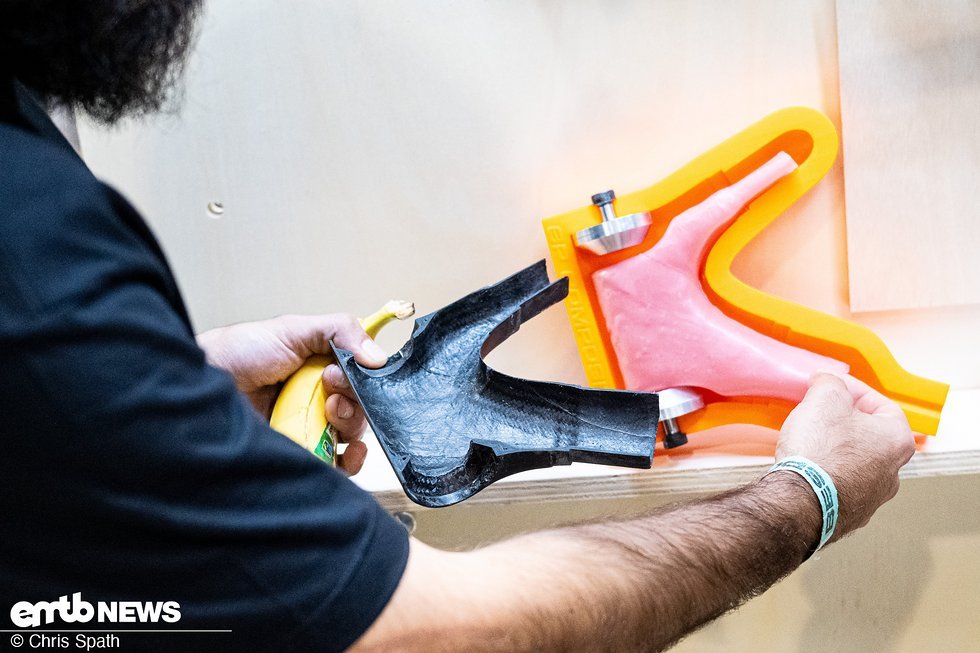
We use a precision bladder moulding process supported by a thermoplastic internal core. During curing, the bladder ensures consistent compaction of the laminate, while the thin-walled core is later removed, leaving a smooth and controlled internal surface.
This results in a clean interior, free from irregularities — something that directly affects both structural integrity and long-term durability.
In lower-quality manufacturing, poor compaction can lead to internal folds, sharp edges or excess resin buildup. These imperfections are not just cosmetic — they can create stress concentrations and, over time, lead to cracks or damage to internally routed components.
Our approach ensures full control over the internal structure of the frame, not just what’s visible from the outside.
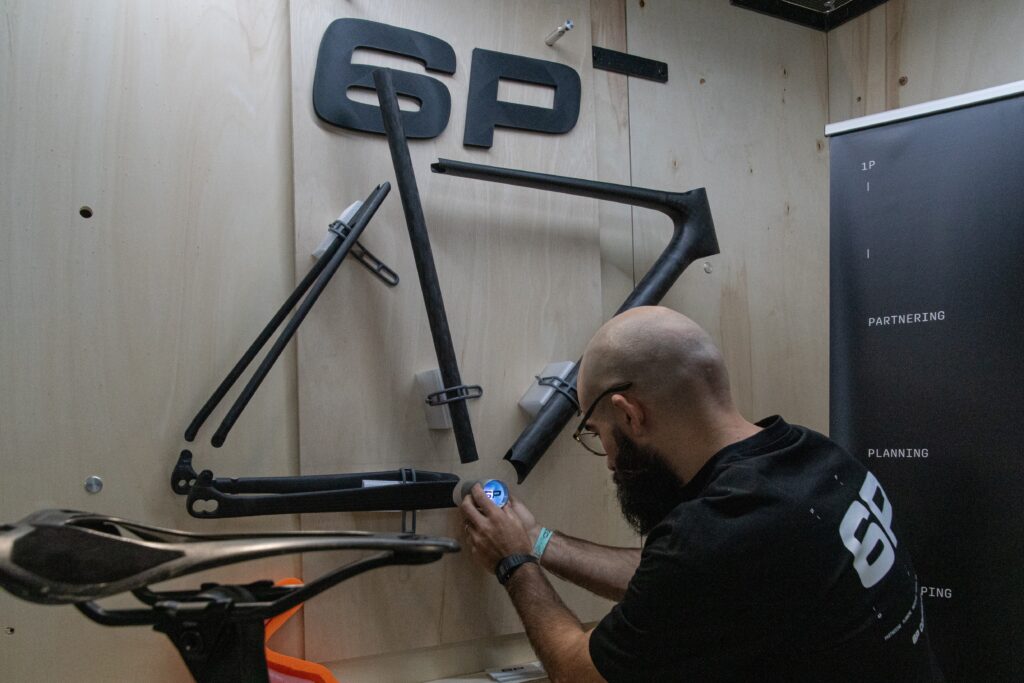
Our frames are built using a hybrid construction approach that combines the advantages of different manufacturing methods.
The front triangle (head tube, top tube and down tube) is formed in a single process, ensuring structural continuity and efficient load transfer. Chainstays with dropouts and seatstays are designed and manufactured in-house
A precisely engineered interface between the seatstays and chainstays allows us to scale the design across a wide range of frame sizes — from very small to very large — while maintaining consistent performance and proportions.
All remaining joints are assembled using a tube-to-tube process, vacuum-bagged and oven-cured to ensure proper compaction and structural integrity.
The bottom bracket shell is in the T47 standard, CNC-machined locally with additional surface features to improve bonding. It can be made from titanium or aerospace-grade aluminium, properly isolated from carbon using a glass fibre barrier.
The seat tube is filament-wound for controlled properties. To improve comfort, we intentionally avoid longitudinal fibres, allowing for a more compliant ride without compromising strength
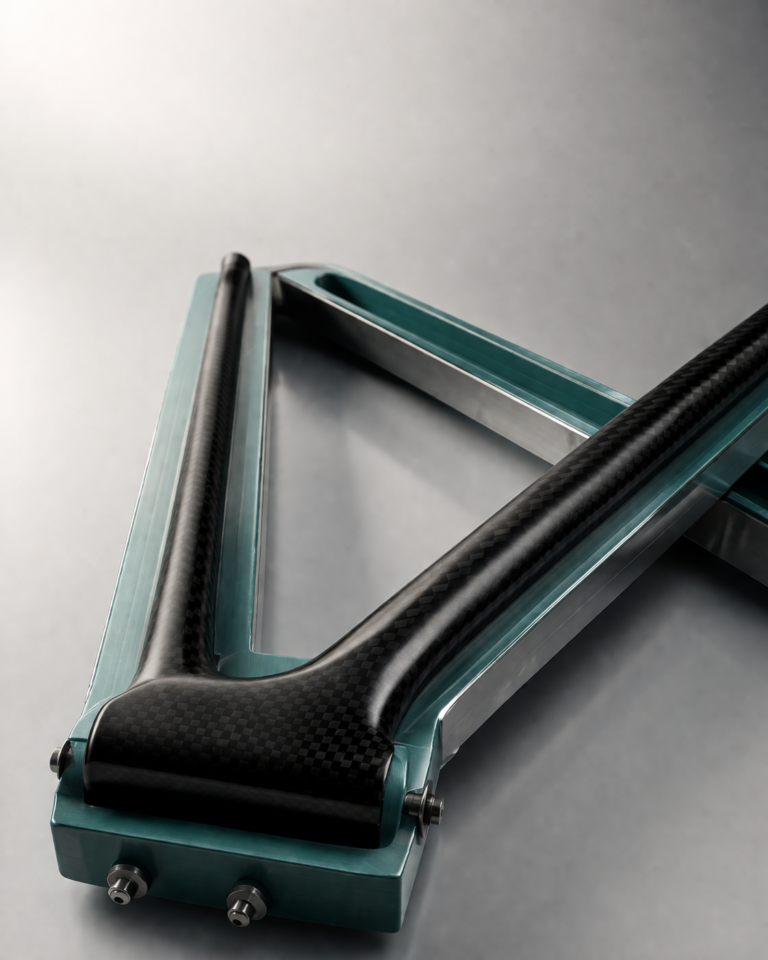
Our front triangle tooling has been designed with adaptability in mind. By changing just a single element, we can adjust head tube height and the angles between tubes — allowing us to create truly custom geometries without the need for multiple full mould sets.
This approach significantly reduces tooling complexity and enables us to keep production local in Europe, without compromising flexibility.
The interface between moulded components, along with the prototypes required to refine it, was one of the most challenging parts of the development process. It demanded time, iteration and careful engineering — but it now works exactly as intended.
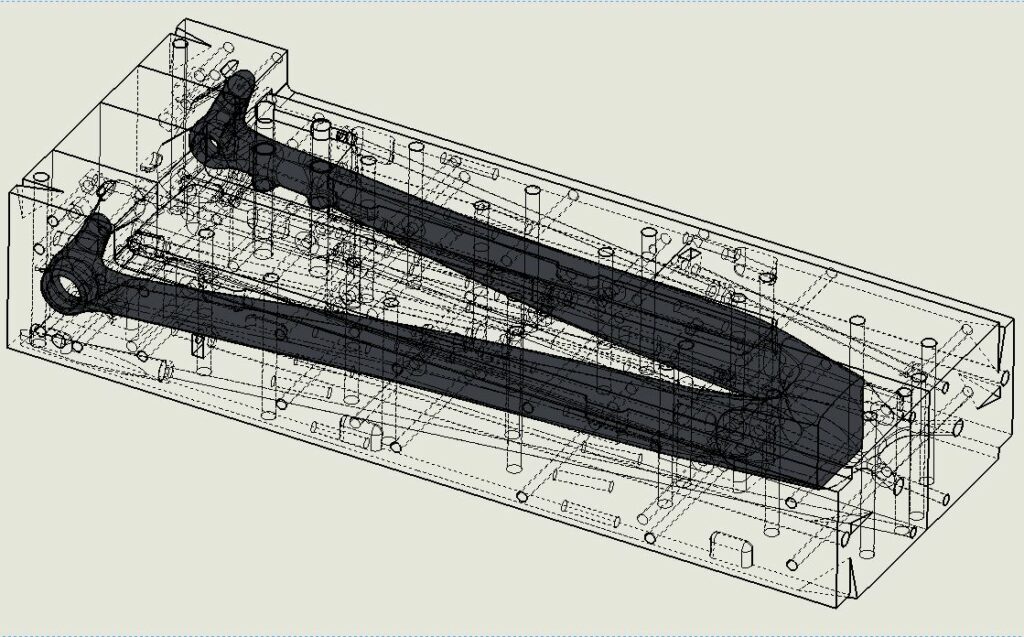
We design everything ourselves — the frame, the manufacturing process and the tooling behind it.
No off-the-shelf frames. No rebranding. No shortcuts.
Full control over the entire process allows us to create frames that are not only unique in geometry, but engineered with intention from the inside out.